

Women in Tech: Flora Worley

undefined or mostly null.
Don't be intimidated and don't listen to all of the folks talking about tools you "need to use". Learn new tools as you run into issues they'll solve. Let your projects lead your learning path..
— Flora Worley

I interview leading women developers every week and showcase their history, opinions, and advice on the tech. In case you missed our previous interviews, check out the series on Hashnode.
If this interview was helpful to you, please share it with your friends and colleagues and help others 🚀🙂.
Today, we will be interviewing Flora Worley 👩💻 .
Flora is a UI Engineer, ReactJS specialist with 5 years experience building React apps and 2+ years working with GraphQL and associated front-end frameworks, Apollo and Relay. Flora has participated as a mentor in Django Girls events on several occasions and co-founded/ organized the Portland chapter of Pyladies.
Please tell us a little bit about yourself. How and when did you venture into tech?
Flora: Despite my parents being ahead of the curve -- my dad started programming in the 1970s and my mom bought an Amiga in the mid-1980s for its graphics capabilities (she was an artist) -- I was slow to adopt tech as both a user and maker. It wasn't until the 2008 US Stock Market crash interrupted my run at a Ph.D. in the humanities that I even considered a career in tech. At the time I remember looking around and thinking, "Who's hiring?" The answer, at least in Seattle, was tech and healthcare, and I had just finished my MA and was not about to go to med school! I ended up enrolling in a night school program where I learned basic HTML/CSS/jQuery, and right about when that ended attended an event organized by Michelle Rowley in Portland that was based on the Boston Python Workshop. Python is really what hooked me on learning to program, and being involved in PyLadies provided me with the support and network to continue to learn and eventually land my first job.
Can you briefly tell us about your job title?
Flora: I lead development on the front-end of a financial services product that supports institutional investors. I'm not even sure, but I believe my title is technically "Software Engineer" :)
What difficulties have you faced on your way in tech? Have you ever felt like you were not treated as equal?
Flora: I've been really lucky in a lot of respects in my career, particularly with respect to those I've had the pleasure of working with. Coming from the academic industry, which is light on opportunity but takes years of formal education and training, it still feels like I won the lottery in having found a career in tech (so much opportunity!) as a self-taught programmer. That said, there are a few things that are popping up specifically as a "mid-career" woman in tech. The first is that no matter the depth or duration of my experience when I meet new people in tech they almost invariably assume I'm new to the industry. It's also pretty rare that folks at conferences and in other semi-social venues engage me on technical topics rather than cultural ones -- not that those are more important, but I highly doubt that's the experience of most men in the industry. The last thing I'll bring up is that even though I have had regular and substantial pay increases, I've never had a title promotion. On the one hand, this is understandable since I've mostly worked at small startups with flat org structures; on the other hand, it does start to lend to the sense that one's career is stalling (even as professional growth and impact may be continuing apace.)
If there’s a bias women face, why do you think it is still there, in the 21st century? What are some things people and organizations could do to change this?
Flora: There is a sense I get at times that there's a kind of blindness towards the blatantly obvious that allows these biases to persist. I suppose that's the textbook definition of "normalization" - as an industry, tech has accepted that it's normal that on average ~85-90% of engineering teams will be male (and mostly white). So there's that. More distressing to me is that I continually have conversations with people in management and E-team roles (mostly men, mostly white) who aren't listening to underrepresented folks, aren't making a point to follow them on Twitter, aren't seeking to engage them where they're at, and who try to propose solutions that are thus naive and doomed to fail. Nothing will change until a space is opened up for underrepresented folks to lead that change.
You are passionate about building communities from organizing conferences to meetups to workshops, why's this and what's your motivation?
Flora: I am not as active in organizing as I used to be back in my PyLadies days, but I am still passionate about bringing women together and in connecting people in general. On the one hand, I have selfish motivations (I want to make more friends!) and on the other, there's just no better feeling than being a conduit for opportunity. If I can connect two people who will teach each other something, or hire one another, or found a project together -- that's the best.
You co-founded and organized the Portland chapter of Pyladies (An international organization focused on increasing the participation of women in the open source community). How has running this been?
Flora: I can't imagine a better way to have started my journey in tech than through participation in PyLadies. PyLadies gave me a purpose, momentum early on when I needed it, friends, mentors, a safe space to break my brain and rebuild it over and over. I really can't even explain how amazing our group was in those early years, and how much I am in awe of the trajectories those women's careers have taken. I haven't organized for several years, and if I'm honest programming hasn't been quite as fun since.
You currently work as a UI Engineer. How long did it take you to arrive here and what significant difficulties did you face along the way?
Flora: Hah! Well, one of the funny things about my start is that I spent a ton of time learning Python, did an internship writing Python and Django, and then was hired in my first role to write JavaScript for the Sprintly front-end. Big shout-out to my coworker Chris Forrette for mentoring me with infinite patience as I begrudgingly learned JS. The toughest part, btw, was switching from a mostly synchronous paradigm to an asynchronous one; that and learning to live without Python's accessor methods and other nifty tools JS lacked at the time for working with different data structures.
You are a ReactJS specialist with 5 years experience, how and what resources did you use to master React?
Flora: I started using React after attending Christopher Chadeaux's talk about React's architecture at OSCON in 2014. Most of my experience at that time was in Backbone, and our team at Sprintly had been having a really difficult time nailing down several race conditions related to paginated fetching and cache updates. I think I intuitively understood the value proposition of React and it's one-way data flow paradigm early as a result. I can't recall how I learned React itself other than through reading the official docs (particularly Pete Hunt's "Thinking in React" article), but I believe the first practical step I took was rendering some JSX in one of our Backbone views. At that time, Sprintly had just merged with a company called QuickLeft, and QuickLeft's co-founder and CTO, Sam Breed, was also pushing React for many new projects. I don't think much has changed in the sense that figuring out how to build and bundle a React project is the greatest hurdle to overcome.
We see that you work predominately in Front-end Engineering, JavaScript, ReactJS and GraphQL. How did you decide to focus on these paths?
Flora: First, let me say that if it weren't for React and ES2015 I would be a full-time Python developer right now! (I still write Python ~10% of the time.) In terms of React, and besides the general ergonomics and freedom from so many of the bugs I've experienced when using other front-end libraries and frameworks, it's really been about the community. I really love all of my friends in ReactJS I've met over the years on Twitter and at conferences. As far as GraphQL goes, I just fell in love with it from first use. I don't think it's the right tech for every job and there is definitely some room for improvement in the surrounding ecosystem, but on balance, GraphQL renders a whole class of issues I face on the front-end moot (I never need to worry about nested fetching for dependent data and all of the complicated branching logic around error handling therein.) It's really been a major win for the projects I've used it on.
What advice do you have for a newbie or intermediate who dreams to work as a UI Engineer.
Flora: Don't be intimidated and don't listen to all of the folks talking about tools you "need to use". Learn new tools as you run into issues they'll solve. Let your projects lead your learning path. Static site generators can be a great tool for learning the ropes (hi Gatsby!), as can tools like create-react-app and similar. Don't worry about the build tooling, learning TypeScript, or mastering the latest CSS postprocessors -- just concentrate on building UI. Work out from there :)
How long have you been in tech and what word will describe your experience so far?
Flora: I've been working in tech for 8 years now. The word that describes my experience so far is "engaging"!
You are an open source sustainer. How and when did you venture into Open Source and how has it affected your career?
Flora: I have a few small open source projects, most/all of which are in need of updating :P I'm not sure open source has changed my career yet, but I hope it might factor in more heavily in the future. We'll see ;)
What advice do you have for developers who will like to venture into Open Source and how should they get started?
Flora: If I run across a bug in a project I'm using, I'll usually fork it and try to submit a patch back if time permits. That's one low-key option (another is to note where you find docs confusing or lacking, and submit patches there.) I try to make it a practice to always be on the lookout for little tools or components that can be abstracted out of the codebase I'm working on and published as a separate package. That's not always possible given employer contracts, but it's nice when it works out because you've usually tested the code internally and with customers before releasing into the wild.
What do you think needs to be done to encourage beginner developers to learn programming languages and continue learning?
Flora: For me the key thing was to have a space where I felt safe feeling dumb and frustrated around other people because the social aspect of programming is important for sustaining motivation. Seek out other beginners and meet up to hack and learn together, or find your local (or remote) chapter of PyLadies! And Googling is your friend! Google every error you run into! After you've learned enough code to be dangerous and you're working in the field, try to make it to at least one conference a year (even if you have to pay your own way, many confs have scholarships). Attend the talks and take notes, but also make new friends -- you never know what opportunities they'll open up for you!
Imposter syndrome is one problem developers face especially newbies, what is your experience with imposter syndrome, how did you manage yours and what advice do you have for anyone facing this currently?
Flora: When I was new to tech I did suffer imposter syndrome pretty acutely, and actually being a career-switcher really helped. I knew that I was competent in areas other than tech and had a hard-won advanced degree (with honors), so I knew that I wasn't daft or incapable of learning. The most difficult thing for me then was just being patient and learning to not judge myself. Now that I've been in tech awhile, I don't really get imposter syndrome anymore. There are two reasons for this:
- The first is that a number of developers more senior and/or more high-profile than me started talking about the things they don't understand or have experience with. That show of public vulnerability makes it a lot easier to admit what I don't yet understand and accept that as typical rather than atypical.
- The second is that the longer I spend in tech the more I see the deficiencies of our industry and their very real (financial) consequences. No one really has it figured out -- even behemoths like Google and Facebook with all of their resources still haven't figured out how to fix their hiring processes or figure out truly great UX across all experiences. The amount of money that's been lost on failed experiments in Silicon Valley is astounding, and I believe much of that waste could be prevented by widening the circle of key decision makers and actors in the industry.
If we want to build a future that works for everybody, it becomes vitally important for underrepresented folks to own their worth and raise their voices. At the end of the day, it's not about any slight insecurity I might feel; there's a larger mission that is more important.
Rejection emails is another thing that motivates imposter syndrome and depression amongst developers especially intermediates. How did you manage this effectively during your "job-hunting" days?
Flora: Haha, well, circling back to my luck in this industry, I have yet to need to apply for a job and have thus yet to be rejected from one. Starting with my first role, I've always been extended opportunities that I've been mostly interested in pursuing. I'm not sure how I became so lucky, but Joe Stump, Sprintly's founder (now at Salesforce), has something to do with it (he's been one of my biggest supporters and champions throughout my career and has connected me with several opportunities along the way). The closest I got to an actual rejection: I scheduled a phone interview with Facebook to practice my interview skills, and that went awry when the discussion pivoted from casual conversation to a tech screen I was not prepared for. I suffer performance anxiety in certain loaded situations and fully expect that to be an issue in the future, but that doesn't have anything to do with the way I understand my abilities or worth as an engineer and team member. The way I look at it is this: if a company can't figure out a way to discover and make use of an educated, sharp, and driven woman, one who seeks impact and ownership responsibility, then it's either down to a legitimate fit problem and wouldn't work for me either or it's frankly their loss.
What advice would you give to aspiring programmers who look forward to working for companies like Google or Microsoft?
Flora: I don't have any advice because I neither have experience working at those companies nor any real interest in joining them (well, maybe Google someday, but not in an engineering role). I guess seek out and talk to people who work at one of them?
Which of your projects are you most proud of? Can you briefly introduce us to it and why you built it?
Flora: I'm currently working on a project that I'm pretty excited about that is kind of a collection of "how to" guides for developers re: all the life things that surround actual coding -- how to manage money, how to budget, how to invest in professional growth, etc. There are tons of resources out there detailing how to bundle with Webpack, but few geared towards tech workers on how to manage stock options or optimize savings for retirement. That dearth of resources is compounded by the fact that there are generally few resources for women on investing and financial literacy. I absolutely love to geek out on all things money, and I'm hoping I can provide some value and inspiration for others to find a sense of empowerment through developing money management skills. We'll see!
What is the best advice someone has given you that has helped you in your career?
Flora: I remember my grandpa once told me about work, "you have to care. If nothing else you have to care about what you are doing." If I find that I feel apathetic about the work I'm doing or the approach I'm taking to something, I know it's time to move on or change course. If something feels unimportant, that's a signal that it doesn't deserve your effort. Of course, "care" works on another register as well -- the act of caring: for the people you work with, for the people who use the things you make, and for yourself. You have to care and be caring, otherwise, none of it matters and you're wasting your time and everyone else's.
What are your favorite programming tools?
Flora: I love little interactive CLI tools, from the utilities I use every day in the course of development to delightful obsurdities like the telnet Star Wars program (look it up and give it a go if you're unfamiliar). I don't like GUIs for anything I can do on the CLI, even though I have to look up postgres commands pretty much every time I use psql. Is that weird for a (mostly) front-end developer?
What does your development environment look like? Could you please share a photo? :)
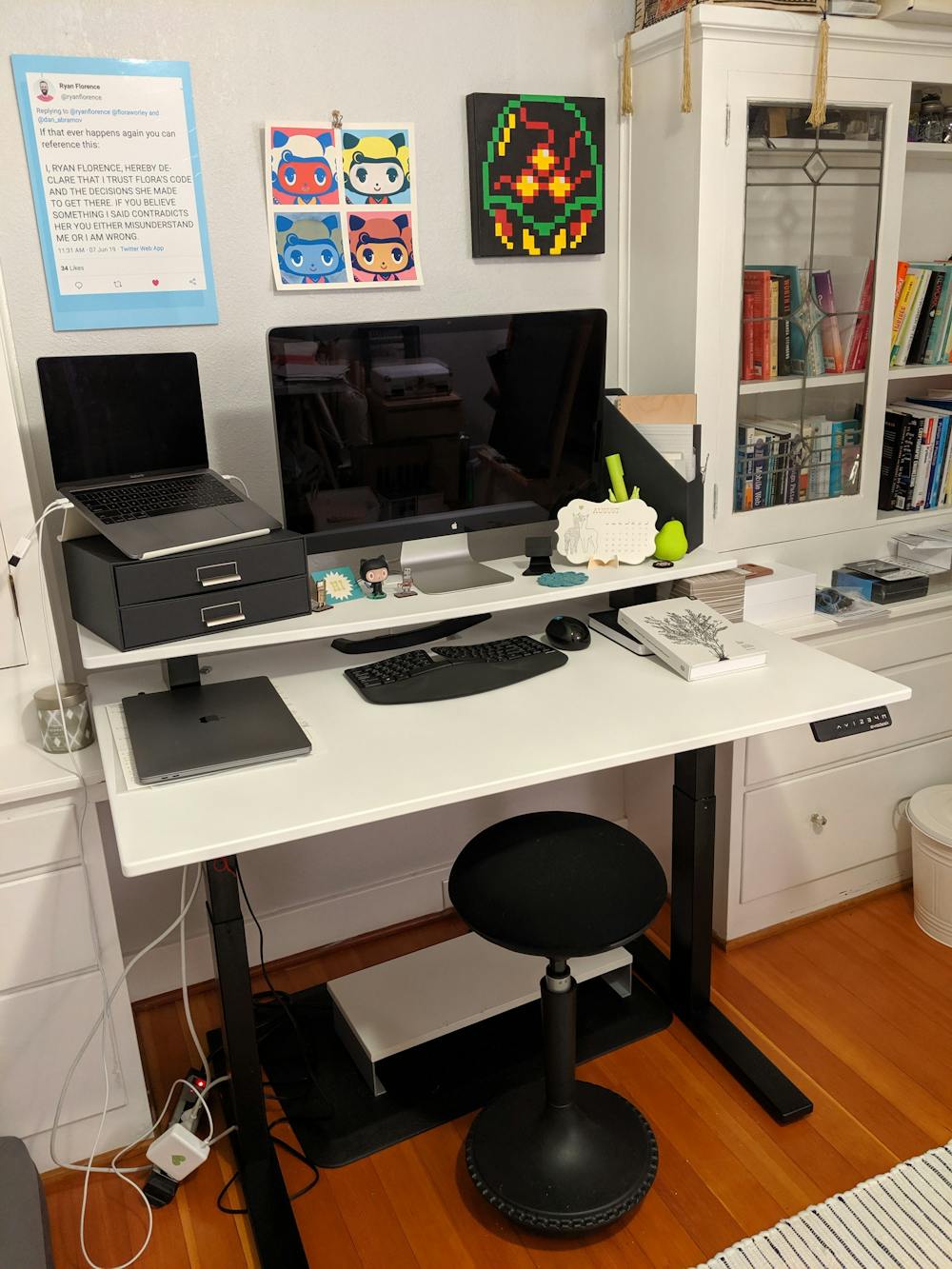
The pixelated Metroid painting was done by my friend Stefan in the early 2000s and remains one of my favorite art pieces. The printed tweet from Ryan Florence is meant to be a joke, but I also look at it sometimes if I do feel the imposter syndrome coming on. Will Larson's An Elegant Puzzle is a permanent fixture on my desk and I refer to it often. Highly recommended! The desk from EvoDesk and I use the Microsoft Sculpt keyboard, which has been a godsend for my wrists.
Finally, what would be your message to women trying to get into technology?
Flora: Be patient with yourself while you're learning and resist the urge towards self-judgement. Be persistent and know that it'll all click in time. Watch out for people who try to control or judge your learning process -- they are just frustrated in their own inability to teach (which is a difficult skill to master in its own right). Get involved in the community and find friends. Try to build something together. Share what you are learning. We need you and you've totally got this!!
Thanks for taking out time to read this interview. 👋
This series is all about talking to the awesome women in tech, understanding the current health of the tech industry and inspiring other women to become better. If you want to share your story, please reach out to me on Hashnode.
Did you find Flora's story useful and inspiring? Write down your thoughts in the comments section below and don't forget to share this interview. You can also follow Hashnode on Twitter to stay up-to-date with our future She Inspires interviews.
See you next time and keep trailblazing 💪💙



![[Changelog]: New additions to Docs by Hashnode, new design components and bug fixes.](https://cdn.hashnode.com/res/hashnode/image/upload/v1728048920904/8f588270-5d7f-4082-b431-35cab56747ed.png)